16.10.2026
RSUH students and teachers explored the features of linguistic convergence in South Asia using the example of the “Kupwar Phenomenon”
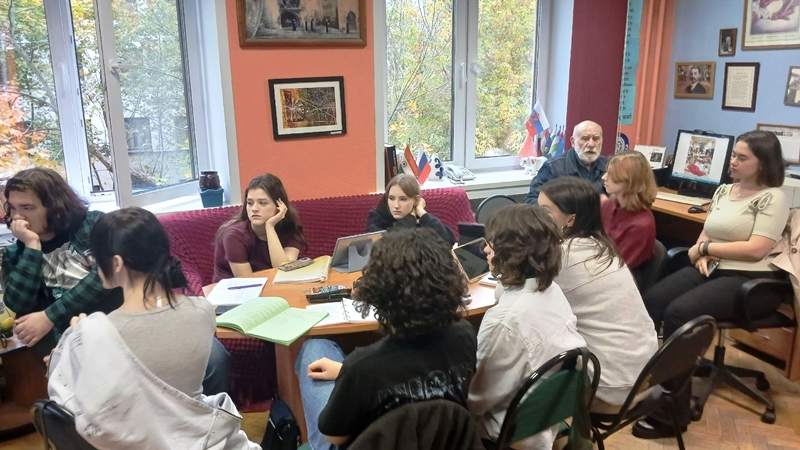
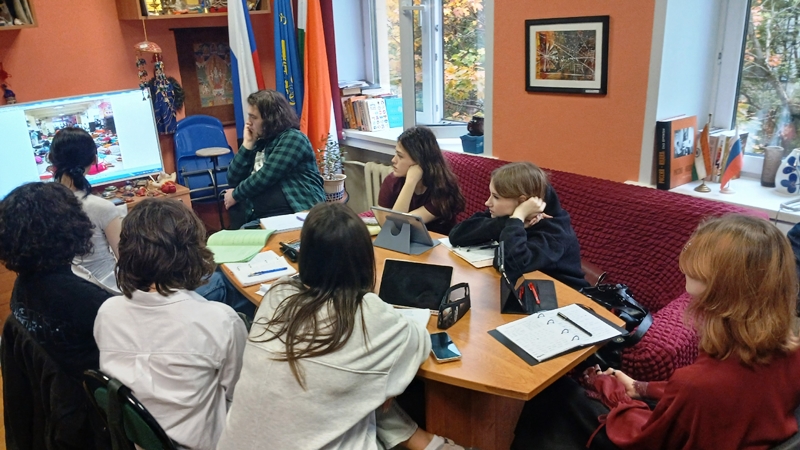
On October 15, 2025, the student research seminar “Interdisciplinary Studies in South Asian Countries" hosted by students of the Department of Theoretical and Applied Linguistics at the Institute of Linguistics, took place at the Russian State University for the Humanities (RSUH).
The seminar topic was: “Linguistic Convergence in South Asian Countries”
Prof. Alexander Stolyarov spoke about the phenomenon of the English language as the primary linguistic bridge in South Asia. He discussed the rapid spread of English-Indian convergence (Hinglish, Benglish) with local languages, which has given rise to new, stable hybrid forms. He also noted that a stable dialect, South Asian English, has formed in the region, featuring specific grammatical and intonational characteristics. This is because the English language connects elites, business, science, and public administration within and between these countries, smoothing out internal language barriers.
Ms. Anastasia Savinskaya, a first-year student, spoke about the Kupwar phenomenon as a classic example of structural convergence of languages while preserving their distinct vocabularies. The student explained that there are three ethnic groups living in the Kupwar Indian village in Maharashtra state, who are speaking completely different languages, These three ethnic groups have lived side by side for centuries: Marathi (Indo-Aryan), Kannada (Dravidian), and Urdu (Indo-Iranian). Over time, the grammar, syntax, and structure of sentences in all three languages became almost identical, trickling together, allowing residents to translate speech from one language into another in words, simply replacing lexes but without changing word order. This phenomenon was described by the linguists John Gamperts and Robert Wilson in 1971 in their famous sociolinguistic study, which proved that languages can exhibit deep structural similarity under conditions of long-term bilingualism without creating a mixed language (pidgin). According to the theory of Gamperts and Wilson, local versions of the Maratha, Kannada, and Hindi-Urdu were used by three different religions: Hinduism, Jainism, and Islam respectively. The three language versions converged on a common morphosyntax, but retained their lexical differences in vocabulary after several centuries of contact. As a result of their centuries-long coexistence, their languages developed an identical syntactic structure (grammar), while maintaining completely different vocabularies so that each group could maintain its ethnic identity in everyday life.
Ms. Sofia Kalaydjyan spoke about linguistic convergence in South Asia as a classic example of the formation of a Sprachbund (linguistic area), where the main features of convergence occurred at the following levels:
Phonetic level: the emergence of retroflex (cerebral) consonants;
Syntactic level: SOV (Subject-Object-Verb) word order;
Morphological level: adverbial participial constructions;
Grammatical level: dative subject;
Lexical level: the emergence of complex (compound) verbs.
The student also noted that convergence is a two-way process: the English language in South Asia acquires local intonation, retroflex sounds, and calqued constructions, while local languages actively adopt English grammatical logic in the digital environment.
This means that languages from completely different families (Indo-European, Dravidian, Austroasiatic, and Tibeto-Burman), having developed side by side for centuries, have borrowed common features from each other: a) retroflex consonant sounds, which are rarely found in Indo-European languages outside of South Asia; b) word order following the Subject-Object-Verb scheme; c) conjunctive participles (absolutes) or the use of adverbial participial constructions.