 16.03.2020
The participants of the round table, held at RSUH on March 13, discussed current issues of historical memory of World War II in Russia and abroad.
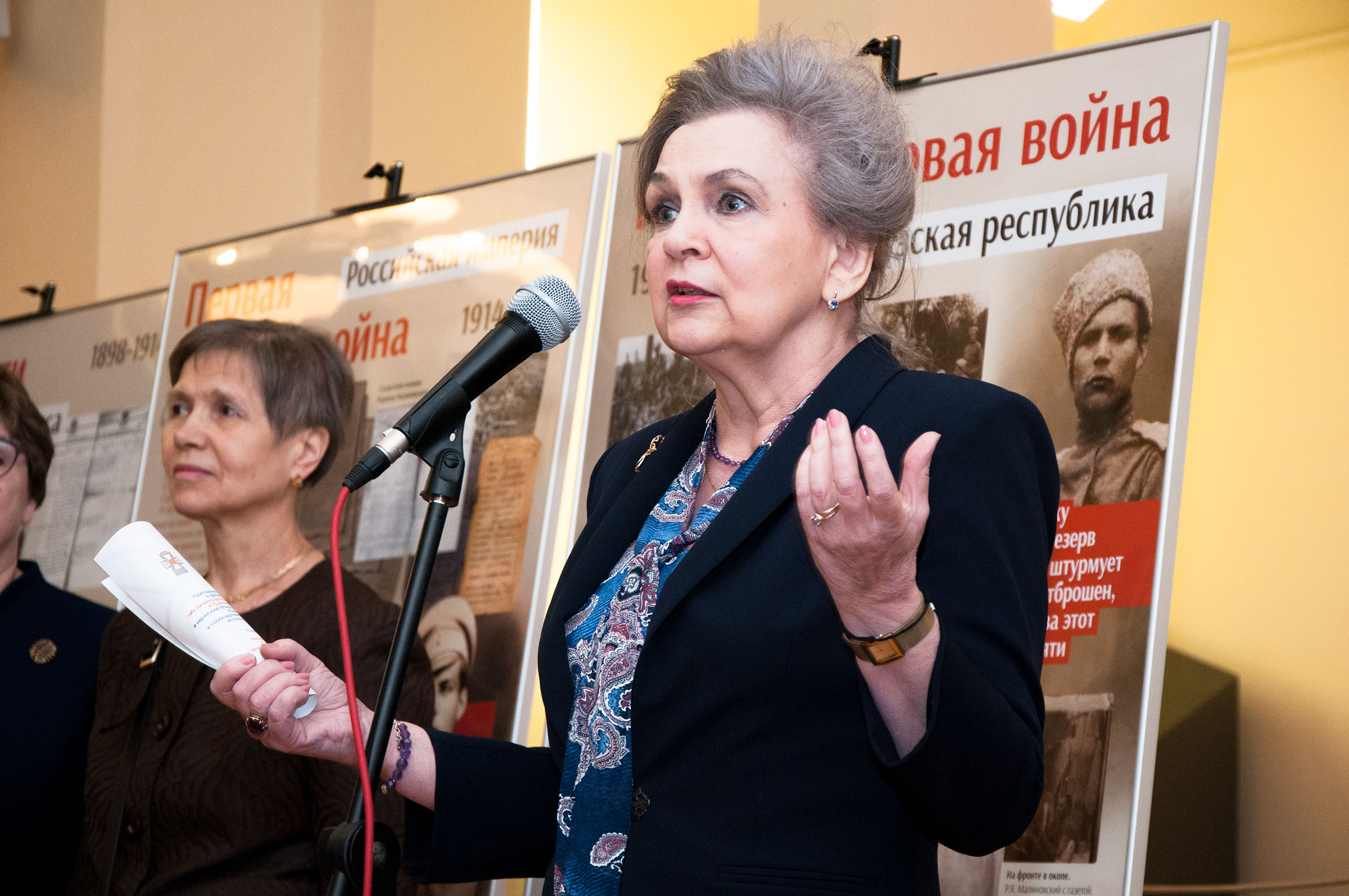
The participants of the round table, held at RSUH on March 13, discussed current issues of historical memory of World War II in Russia and abroad. On the same day, the opening of the exhibition “From the personal archive of Marshal Malinovsky” took place on the occasion of the 75th anniversary of the Great Victory and the presentation of the series of books of the Foundation for Historical Perspectives “True Victory”, commemorating this event.
“Documents from the personal archive of Rodion Malinovsky” will help to take a fresh look at the details of his incredibly complex biography,” Dr. Olga Pavlenko, First Vice-Rector for Research, said in her welcoming speech. - The memory of the great commanders who created the Victory is sacred. At RSUH, this memory will be held in high esteem. It is very important that biographies of people like Marshal Malinovsky be included in educational programs. ”
The Exhibition was organized by the Military Convocation Foundation. The basis of the exposition comprises the materials presented by the Marshal's daughter, Natalia Malinovskaya. Vivid details of the Marshal’s life, a strictly documentary yet fascinating format can, through the biography of an outstanding military leader and statesman, in which many events, topics and names significant for our history are mentioned, arouse an interest of the general audience in studying the history of one’s own family and the country's history.
Natalia Malinovskaya drew attention to the fact that in talks about the war, as a rule, two names popped up, Stalin and Zhukov: “But people do not think about the fact that we had 10 fronts and that two people could not have defeated the enemy on such a vast territory. Therefore, what is happening today is amazing, and thank you very much for that.
Ortega y Gasset once said: “I am myself and my circumstances, and if I cannot cope with them, I will not cope with myself.” This strife of man and circumstances was especially noticeable in the 20th century. And no matter how impressive the statistics, a separate standalone life is more impressive. It is necessary to grow up to memory, as it were. I began to look into the life of my father as an adult, and could not imagine that I, a specialist in Spanish surrealism, would end up researching World War II. It turned out to be no less interesting. I managed to get my hands on Father’s archive, which had begun in 1944 and ended 20 years later. With great difficulty I managed to find my father's memoirs that had been confiscated, the manuscript about the years 1941-42. I promise to have it published it in the coming year. The topics of the Spanish War is an absolute terra incognita. When I worked in the archive on Admiral Makarov Street, I was shocked that only five people had requested the Spanish Archive since 1939. But it’s a gold mine! Not a single conflict have had such a cultural echo as the Spanish War. I think it is worthy of your attention. ”
In turn, Dr. Mikhail Kozhokin, Vice-Rector for Development and Information Resources was certain that the history of any family in Russia was somehow related to the Great Patriotic War:
“The war crossed everyone. Now we have in front of us the life of the Minister of Defense, an Army Commander, a great military leader. But in the same vein there are lives of ordinary soldiers, and their study is no less interesting. My grandfather joined the militia in August 1941. In October, he was missing in action. Many years have passed, and I was able to learn at least the place of extermination of his regiment during the atrocious defensive battles. But the most important thing is the people you meet when you are looking for information. Some will help out of the goodness of their hearts, some won’t, but everyone is somehow involved in the complex process of restoring the fate of their ancestors. This is a life experience of unprecedented scale. ”
Dr. Vasily Khristoforov, Head of the Department of International Security, recalled that Marshal Rodion Malinovsky had participated in many wars: “It was World War I, the Civil War, the Spanish War and, of course, the Great Patriotic War, which for Malinovsky did not end in May 1945 as he still had to lead troops in the Far East. A unique person, he was. It will be useful for students to learn about him as much as possible. ”
Dr. Nadezhda Arkhipova, Vice-Rector for Academic Affairs, warned students against attempts to falsify history: “For an objective assessment of historical events, the real facts are needed. And only work in the archives allows you to identify the real details of certain events. The method of studying history through the biographies of great people is a great lesson for all of us. ”
Dr. Elena Rudaya, academic director of the Exhibition, said that she had to choose from a vast array of documents. Therefore a catalogue was published that included texts and photographs that did not appear on the stands. The catalogue was solemnly donated to RSUH. Also, a two-volume book “From Moscow to the X-Country”, a book of memory of Soviet volunteers for the Spanish Civil War 1936-1939”, “Stalingrad in 1942-1943. Hitler’s greatest failure”, was transferred to the Library of the University, along with “Peace between wars. Paradoxes of the Interbellum ”.
The round table “Memory of Victory” was dedicated to the preservation of historical memory, correcting falsifications of history and the inadmissibility of belittling the importance of the USSR for the Victory in World War II. All reports aroused active discussions.


