In anticipation of the non-profit screening of “Union of Salvation”, Dr. Oksana Kiyanskaya talks about why the new adaptation of the Decembrist uprising received a slew of contradictory reviews, whether people know history well and what is the global meaning of studying history.
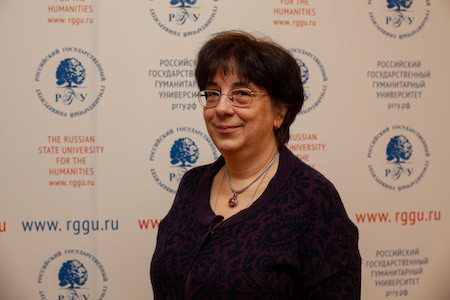
- On February 26, a non-profit screening of the film “The Union of Salvation” will be held at RSUH. How relevant is the topic of the Decembrist uprising for the Russian politics of today?
- I had thought about it before the movie was made. It seemed to me that the Decembrist uprising did not affect modern Russian politics in any way. The politicians appeared to be concerned with other historical topics. Moreover, I thought that in addition to a few people who were professionally engaged in this topic, no one was interested in the Decembrists per se, that this topic had left public discourse.
Yes, I worked with Maksimov and Vysotsky for about a year (Anatoly Maksimov is the producer and Nikita Vysotsky is the author of the script – Editor’s Note) That was 7 years ago. I read the first version of the script. Upon this, my role as a consultant was over, and I did not participate directly in the creation of the movie itself. About six months ago, they told me that they had wrapped and soon there would be a premiere. I, like everyone else, saw this film in a movie theater. And that is when the fun began.
- Why did this film provoke such sharp criticism from the standpoint of modern politics?
- My fellow historian, who collected these reviews, counted about four hundred of them. I think that all in all there have been about half a thousand reviews, if you count the Facebook texts. Yes, many of these reviews, actually about half, are negative. The things they saw in this film! In particular, direct allusions to contemporary times. It all started with the famous film critic Anton Dolin, who wrote that the “Union of Salvation” is the present, dressed in the attire of the Decembrist era.
Why such reaction? I think there are several reasons. On the one hand, the film was made with the support of Channel One, which is considered pro-government, and one of the producers is Konstantin Ernst. Liberal critics are certain that Channel One cannot produce anything but the ridicule of those who go out to fight against the authorities. This was precisely what Dolin’s review represented. And then most of the critics, who gave negative reviews, just joined in. However, everything is not so simple. I know many liberal-minded people, who even took part in various protests, who liked the film very much.
They defended the film, saying that you need to separate politics and cinema. I personally liked the movie. It cannot be reduced to being a piece of state propaganda, a monarchist blockbuster. And, of course, the Decembrists in this film are completely unlike the liberals who go to rallies.
- What is the movie about?
- The main idea is the relationship and the rift between the State and the intellectuals. The tragedy of the situation is that they cannot find a common language. There are no conclusions about who is good and who is bad. Everyone is good in their own way. The film is made in such a way that each viewer can relate to any of the characters. To the emperor, to Muravyov-Apostol, to Pestel, Obolensky, Kakhovsky, General Miloradovich. Very handsome actors play there, too, so choose anyone you like. The film does not force upon you any unambiguous, predetermined conclusion. In addition, the enlightenment idea present in the film is very close to me personally.
The consequences of this film are beyond the scope of reviews. It is no longer in cinemas but the comments do not abate. I know that this film is being taken very seriously by both the student and high school community. Students feel the need to discuss what it was, who was right, who was to blame. I know that young people read serious books so the level of discussion is quite scholarly. And that makes me happy, of course.
- Do you expect any interesting ideas to come from students? Can you imagine their reaction?
- I can’t even imagine their reaction. Since there is such a heated discussion on the Internet, you can’t predict anything. It could be new ideas or criticism. We will see. I can only try to comment on the historical backdrop of the film.

- The year 2020 is the year of the 75th anniversary of the Victory in the Great Patriotic War, a big event for all of Russia. But that was the second Patriotic War. The first Patriotic War was in 1812, which prompted the Decembrist uprising on Senate Square. Why do we seem to have almost forgotten the war of 1812?
- There are serious reasons. Any ideology is based on the opposition of good and evil. The fascism is an absolute, unprecedented evil. But if we talk about the war of 1812, it is not so simple. Napoleon, of course, was an invader, but that was not the only thing he brought to world history and culture. He was the heir to the ideas of the French Revolution. Russia did not just fight Napoleon, it also learned a lot from him. And relations with Napoleon were not always hostile. There were Treaties of Tilsit, there was fraternization of two emperors, reflected in documents, in literature, in historical works. In addition, the culture of the early 19th century upheld Napoleon as a romantic hero. A strong, brave hero. Remember what Pushkin wrote? "We are all looking to be Napoleons". In other words, the Russian people, even having defeated the Corsican, did not perceive him as an absolute evil. Therefore, his image can be of little help as regards state ideology.
- Do you think that the students, who come to you, know history well?
- Our whole society does not know history well. Neither do the students. But this is not only a Russia-specific misfortune. I teach abroad and I see that there, too, students are completely ignorant of history. They know very little about World Wars I and II. We are witnessing the period of the decline of the humanities all over the world. Departments of History are being phased out, relevant funding curtailed. Unfortunately, the same thing is happening both in Russia, in America, and in Europe. If people, who have power and money, do not pay attention to the liberal arts knowledge and education, the consequences for future generations will be simply catastrophic.
- What is the global importance of studying history?
History teaches only the fact that it teaches nothing. It is useless to study history in order to find solutions to improve our current situation.
So we are going around in circles?
- We are, but everyone has his own circle. A historian may research any topic but he still describes his times and his experience. I've written a biography of Pavel Pestel. I strive for objectivity, compare documents, draw some conclusions. But I am a historian, teacher, I am a woman, I live in the 21st century. The hero I am writing about is a man, an officer of the beginning of the 19th century, a war hero, and the leader of a political conspiracy. And these differences … will stop me from fully understanding my hero.
One of the areas of your research is the history of national journalism. How do you rate its current?
- The situation with journalism is gave. But journalism is but a reflection of society. They say that journalists are liars. Of course they lie. But when have they not lied? Even in Pushkin times they lied: just recall Grech and Bulgarin. But, on the other hand, it’s not only the journalists that lie. Besides, everyone has the right to an opinion, and that opinion does not necessarily coincide with the opinion of someone else.
- Last question. What are you currently working on?
- “Union of Salvation” turned my creative plans upside down. For several years I had not been thinking about the Decembrists, I (in collaboration with Dr. Feldman) have written several books on repressed Soviet writers and journalists. But now, ever since I was sucked into this discussion, my immediate plans include writing a comprehensive book about the Decembrists. I think that the book should not be so much about the Decembrists, but about us. The sources of the book will be, in particular, the reviews of this film.


